// Aircraft Design
ATR 42-600 Sustainable Redesign for 2035
Team redesign of a regional turboprop targeting a 20% sustainability improvement by 2035 via a hybrid-electric, LN₂-cooled propulsion system.
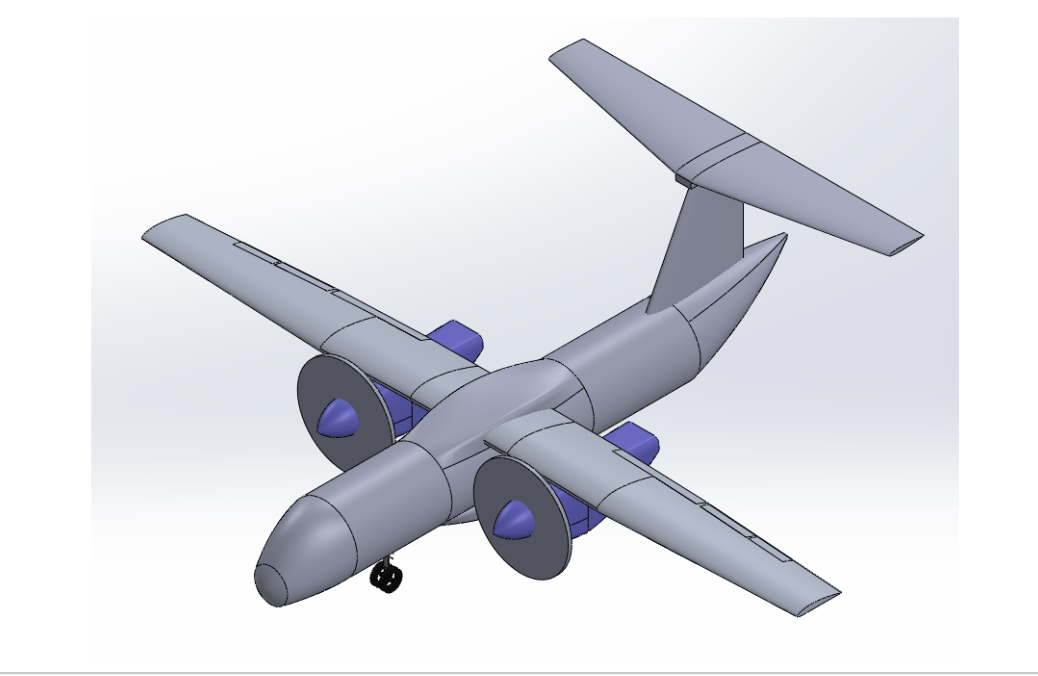
Overview
A four-person aircraft design team tasked with redesigning the ATR 42-600 regional turboprop to be 20% more sustainable by 2035. We reworked propulsion, aerodynamics, and structures with a 2035 technology baseline.
Approach
The team ran trade studies on propulsion architectures (battery-electric, hydrogen, hybrid-electric, SAF) and aerodynamic refinements. After comparing energy density, infrastructure readiness, and emissions impact, we converged on a hybrid-electric system using liquid nitrogen cooling for high-power-density electrical components, paired with optimized aerodynamic surfaces. Sustainability gains were measured against the baseline ATR in CO₂ emissions and fuel burn.
My contribution
I led the propulsion system selection — running the trade study, justifying the hybrid-electric + LN₂ architecture, and sizing the system for the mission profile. I also contributed aerodynamic calculations supporting the redesign and built CAD geometry in SolidWorks for integration with the team's airframe model.
Result
The redesigned aircraft met the 20% sustainability improvement target on CO₂ and fuel burn for the design mission, with a credible 2035 technology readiness pathway documented in the final report.
Next project
Heat Exchanger →
Thermal-Fluids