// Capstone · Human-Centered Design
Adaptive Golf Prosthetic for a Veteran Amputee
Senior capstone — designing a custom upper-limb prosthetic that returned a sport to a U.S. veteran.
The brief
A U.S. military veteran who lost his left arm wanted to return to golf — a sport he loved before his injury. Off-the-shelf upper-limb prosthetics either don't accommodate a golf grip or strip away the natural feel of the swing. Our capstone team partnered directly with him to design a custom prosthetic attachment that would let him swing a club confidently and comfortably.
Approach
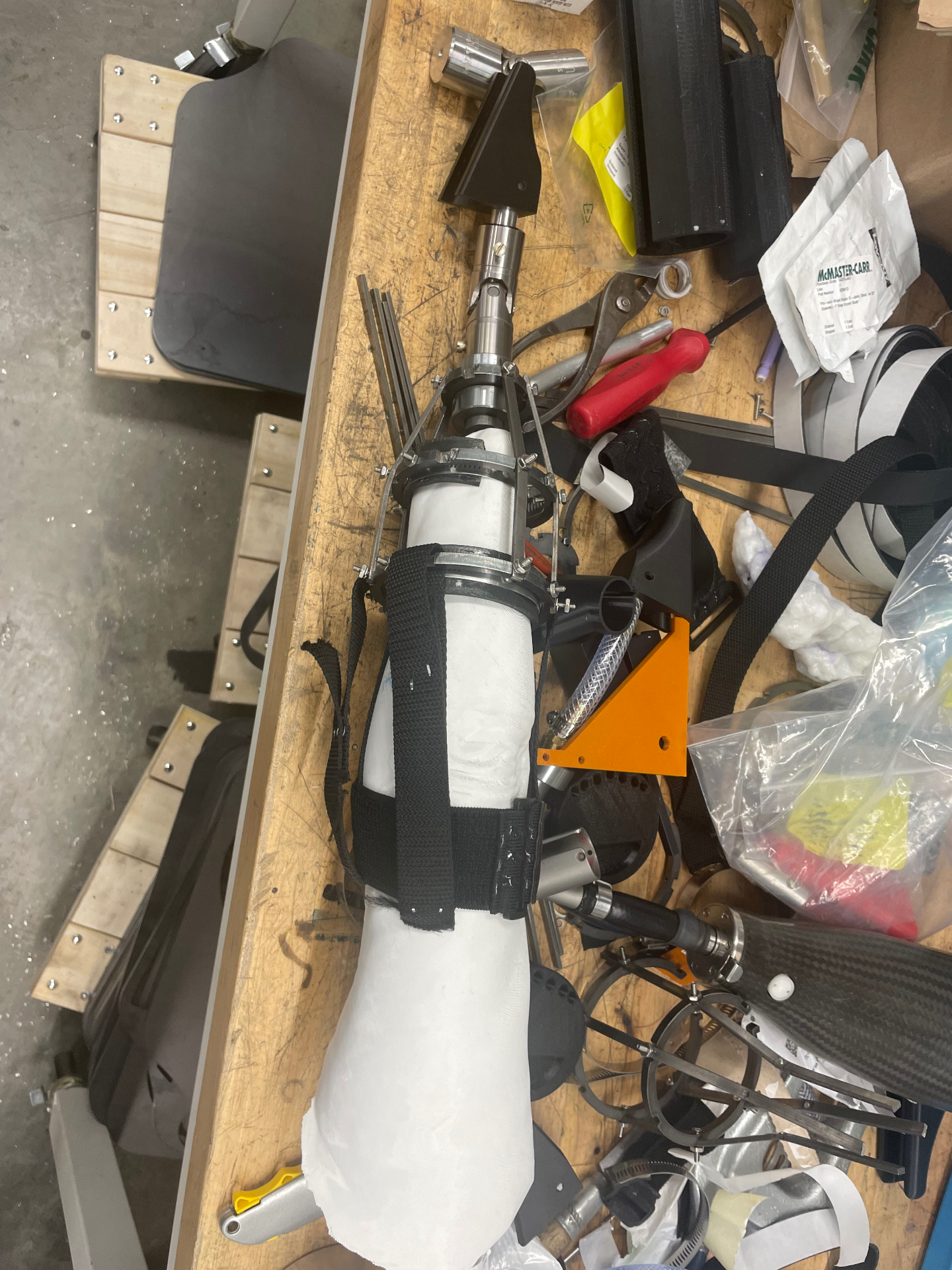
We treated the project as a full design cycle: client interviews, requirements definition, concept generation, mechanical analysis, prototyping, and iterative testing with the veteran. Every design decision was grounded in his feedback — grip release behavior, weight distribution, comfort at the residual limb, and how the device handled the impact loads of a real golf swing.
[ IMG ]
CAD assembly / exploded view
My contribution
I worked across mechanical design and client communication — translating his needs into geometric and material requirements, contributing to CAD, and supporting prototyping and fit testing. The feedback loop with the client was the most important part of the project: the design only worked once it worked for him.
What I learned
Designing for one person teaches you things a textbook can't. Constraints came from anatomy, comfort, and emotion as much as from stress and stiffness. I left the project a better mechanical designer — but more importantly, a more careful listener.
Outcome
A working prosthetic attachment that returned golf to a veteran who thought he'd never play again. The project was the most meaningful engineering work of my undergraduate career.
[ IMG ]
Final prototype with client
Next project
Wing Stress Analysis →
Aerospace Structures