// Aerospace Structures
Wing Cross-Section Stress Analysis (Cantilever Study)
Hand calculations validated against SolidWorks FEA on a 6061-T6 cantilever wing section under a 7,700 N tip load — within ~2% on peak stress.
Overview
For an aerospace structures course, our 2-person team analyzed a thin-walled wing cross-section modeled as a cantilever beam under a 7,700 N normal tip load. The structure was an extruded 6061 aluminum alloy section (E = 69 GPa, ν = 0.33, ρ = 2,700 kg/m³, σ_yield ≈ 55 MPa) built from four solid bodies bonded along their interfaces. The objective was a clean verification & validation exercise: predict the structural response analytically, then confirm it with FEA.
Approach
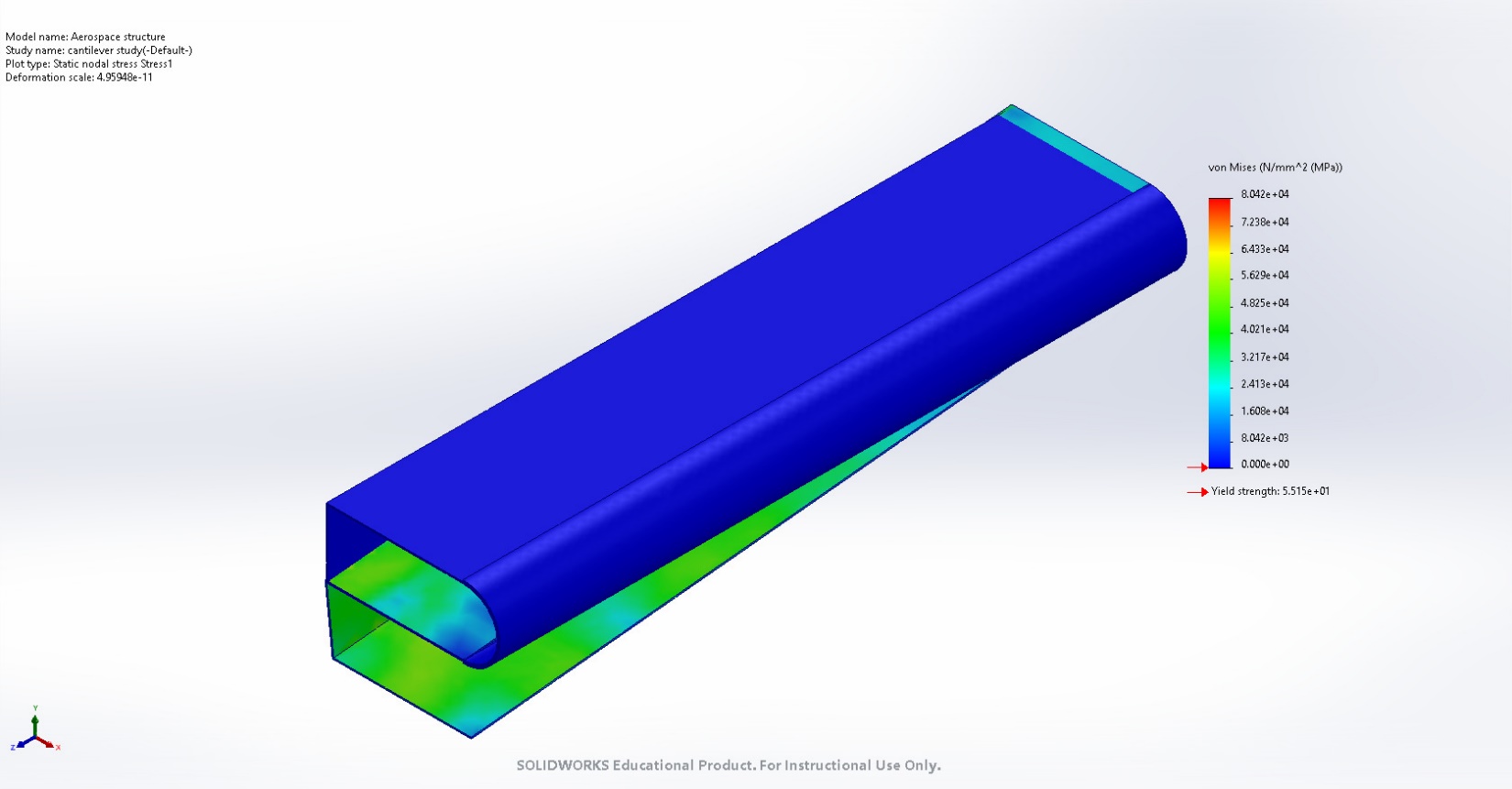
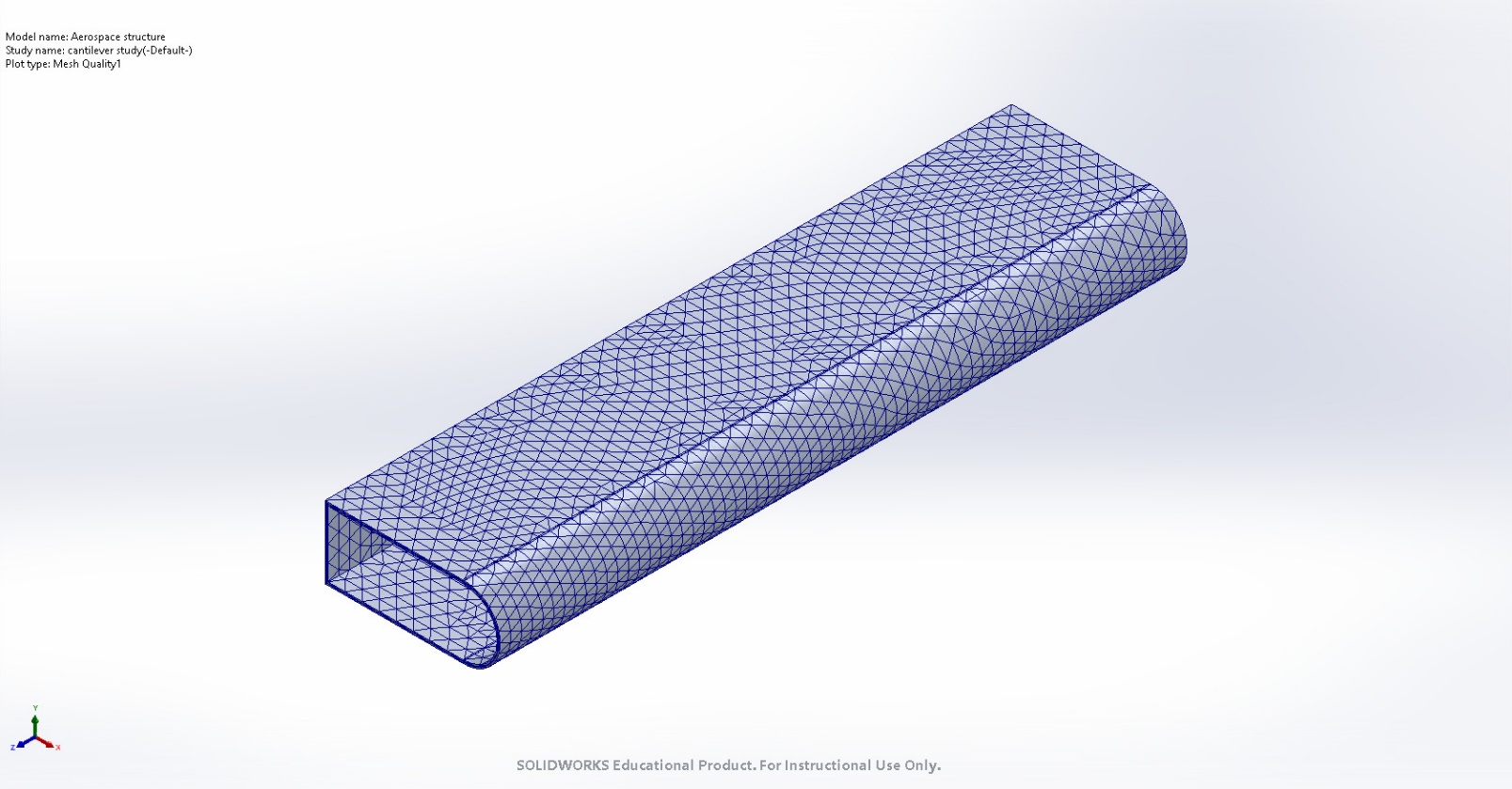
Both team members independently performed hand calculations using classical beam and thin-walled section theory to predict bending stress, shear flow, and tip deflection. I then built a SolidWorks Simulation static study of the same geometry — bonded global interactions, fixed-edge boundary condition, 7,700 N applied normal force on the loaded face, curvature-based solid mesh, and thermal-effect-on linear elastic isotropic material. The reaction force resultant came out to ≈ 77.1 kN, consistent with the applied load and fixture reactions, and von Mises stress / displacement / strain fields were post-processed for comparison.
Figures
My contribution
I owned the FEA workflow end-to-end: SolidWorks geometry preparation, material assignment (6061), fixture and load definition, mesh refinement studies, solver setup, and post-processing of stress / displacement / strain plots. Both team members performed the hand calculations independently so we could cross-check before comparing to FEA.
Result
Peak FEA stress and deflection trends agreed with the hand-calculated values to within ~2% in the regions where classical beam assumptions applied — strong agreement that validated both the analytical model and the simulation setup. The study reinforced how powerful classical methods remain as a sanity check on modern FEA tools, and made stress concentrations at geometric discontinuities easy to spot against the smooth analytical predictions.
Next project
ATR 42-600 Redesign →
Aircraft Design